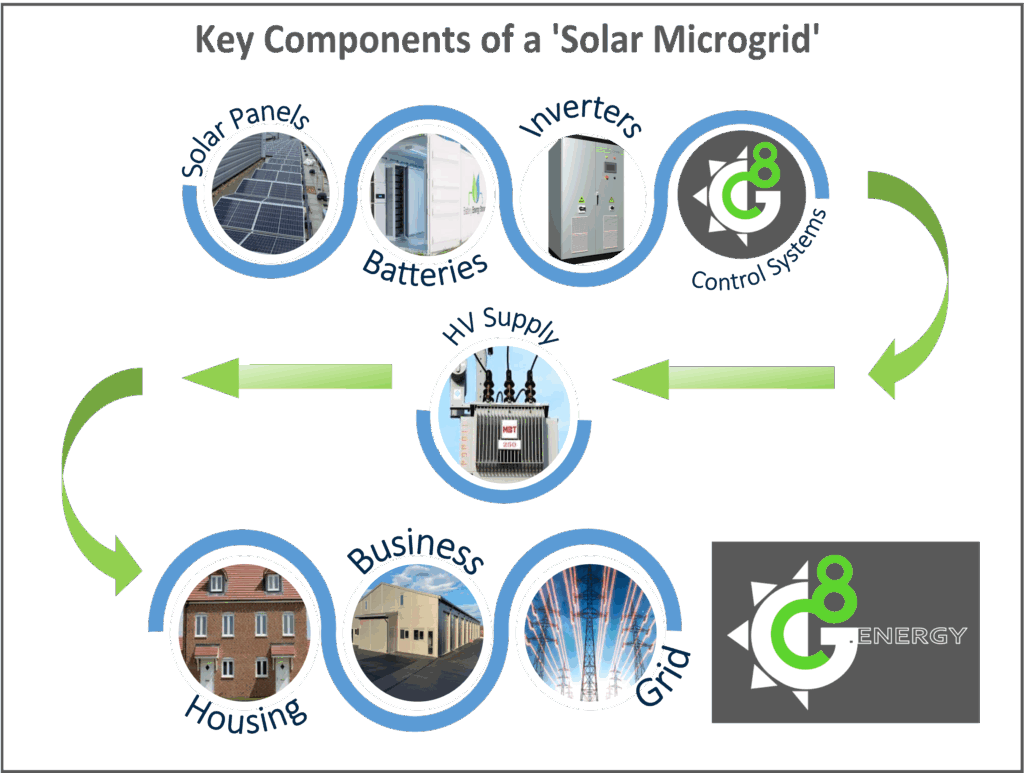
Microgrids are localised energy systems that generate, store, and distribute electricity for a specific area, acting as a single controllable entity that can either connect to the main grid or disconnect to operate independently (island mode). They use diverse sources like solar, wind, or generators, along with battery storage, offering enhanced reliability, cost savings, and resilience against outages, making them ideal for campuses, military bases, or communities seeking energy independence and decarbonization.
Key Characteristics
- Local & Self-Contained: Defined boundaries, serving a specific community or facility (e.g., hospital, university, neighbourhood).
- Island Mode Capability: Can disconnect from the larger grid during disturbances to provide continuous power.
- Diverse Energy Sources: Integrates renewables (solar, wind), traditional generators (gas), combined heat & power (CHP), and battery storage.
- Smart Control: Advanced software manages energy flow for efficiency and reliability.
Benefits
- Resilience: Ensures power during main grid failures.
- Cost Reduction: Optimizes energy use and can sell excess power back to the grid.
- Decarbonization: Supports renewable energy integration and lower emissions.
- Energy Security: Reduces reliance on distant power sources.
Applications
- Remote Areas: Provides power where the main grid doesn’t reach.
- Critical Facilities: Hospitals, data centers, military bases needing uninterrupted power.
- Communities: Housing developments, university campuses, business parks.
How They Work
Control: A central system manages generation, storage, and grid connection.
Generation: Local sources (solar panels, wind turbines) produce electricity.
Storage: Batteries store excess energy for later use.
Distribution: Power is supplied to local buildings via a dedicated network.